Arriving at Yerevan's Zvartnots Airport late at night, the first surprise is the terminal itself — new, modern, efficiently run. Luggage arrives promptly, passport control moves quickly, and the pre-booked car is waiting outside. A smooth entry.
On the short drive through well-lit streets — modernised façades, late-night shops, a proliferation of new clubs — memory reaches back to a first visit in 1997: the decaying Soviet terminal building, a money belt concealing $20,000 in twenty-dollar bills that I had stubbornly refused to declare at customs, a drive through near-total darkness punctuated by police checkpoints where the driver paid his passage toll in cash, roadside barrels of petrol and diesel from which cars were filled by hose, and the Hotel Armenia on Republic Square, its Soviet-era floor attendants still guardedly in place on every storey.
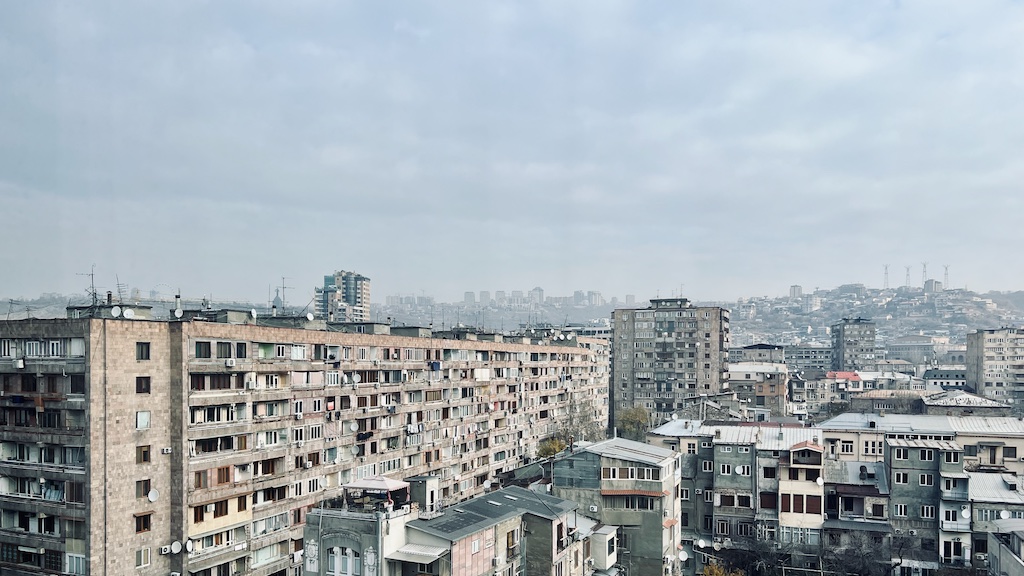
The street grid is more or less intact, and some of the old names are still there — Abovyan, Tumanyan, Pushkin, Armenyan. The back sides of the apartment buildings, visible from the hotel window the following morning, tell a more familiar story: decades of deferred maintenance, renovation backlogs that no boom has quite managed to clear. An Armenian breakfast — scrambled eggs, thick-cut bacon, and the customary arrangement of fresh herbs, basil, rocket, dill, coriander, soft lettuce — sets things right. An evening meal at the new lifestyle restaurant Lavash confirms the general direction of travel: generous, herb-laden, confident.
What strikes hardest, though, is the café scene. Across the city centre, new restaurants and cafés are packed with young people working on laptops — predominantly MacBooks — nursing coffees priced at near-European levels. The question almost answers itself.
Since Russia's full-scale invasion of Ukraine in February 2022, a substantial wave of young Russian professionals — in local parlance the relokanty, from the corporate vocabulary of IT relocation — has settled in Yerevan. Armenia offered what few other destinations could: visa-free entry on an internal Russian passport, acceptance of Mir bank cards, no language barrier to speak of, and a tax regime attractive to remote workers. Estimates put the number of Russians who relocated to Armenia in 2022 alone at around 110,000. Most were in tech, design, and the digital economy — exactly the profile visible in those cafés.
The macroeconomic effect was significant. Armenia's GDP growth figures had to be revised upward substantially as the newcomers spent, rented, and invested. New cafés, restaurants, and co-working spaces followed, some of them opened by Russians for Russians, at prices calibrated to Moscow purchasing power rather than local wages.
The social impact, however, was considerably more ambivalent. Rental prices in Yerevan spiked by 30 to 40 percent in the first year alone, with some apartments doubling or tripling in cost. Local tenants were evicted as landlords re-let to higher-paying newcomers. A sardonic new phrase entered everyday speech: these Russians — a pointed echo, as some locals observed, of the Soviet-era Russian rental notices that had once read renting only to Slavs. The café prices that feel mildly steep to a European visitor represent something considerably sharper for a Yerevan nurse or recent graduate.
By 2024, the wave had partly receded. Rental prices fell back roughly 30 percent from their peak, though not to pre-2022 levels. Many of the relokanty had moved on — to Georgia, to Dubai, to European cities willing to receive them. Those who remained were increasingly part of the urban fabric rather than a temporary disturbance of it.
Layered on top of this was another, far more charged displacement: the arrival, in September 2023, of over 100,000 ethnic Armenians expelled from Nagorno-Karabakh after Azerbaijan's military takeover of the enclave. For a country of barely three million, absorbing this exodus — its own people, without resources, without a path back — was a different order of challenge entirely. Their visible poverty in a city of new café culture and premium coffee prices gives the current streetscape a particular complexity.
Yerevan has always absorbed more history than its modest size might suggest. What feels new, and not entirely comfortable, is watching a city work through the aftershocks of someone else's war while quietly managing its own.