On the TGM from La Marsa to Sidi Bou Saïd
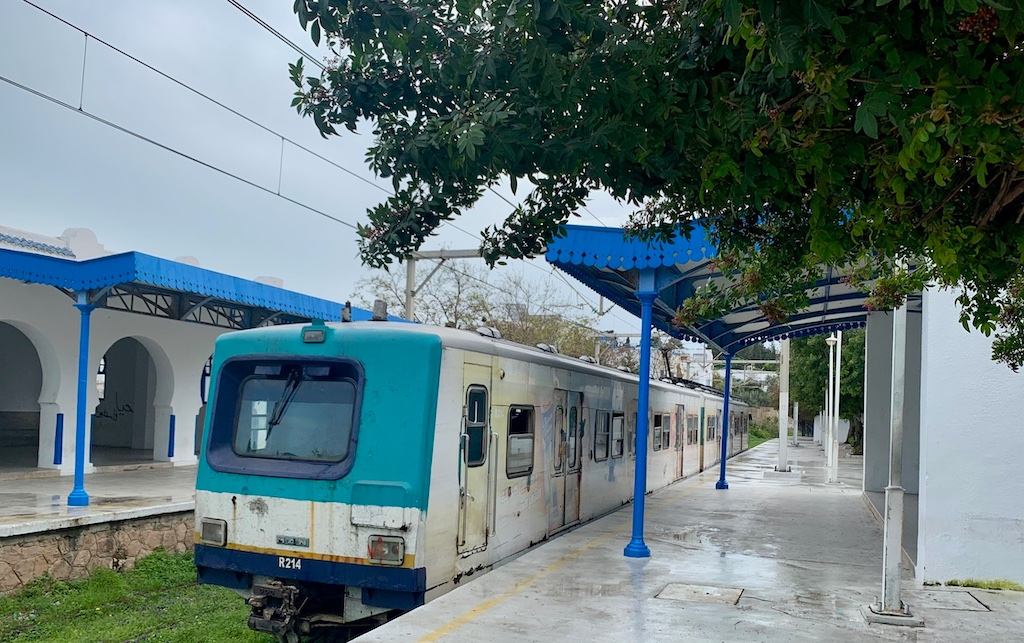
Travelling on the TGM — the Tunis–La Goulette–La Marsa line — from La Marsa to Sidi Bou Saïd. The so-called Train bleu is badly rusted and dented, its once-blue livery faded and battered. The line — opened in 1872 as Tunisia's very first railway, and later one of the earliest electrified suburban railways on the African continent — has, according to an April 2025 article in La Presse de Tunisie, long since outlived its operational lifespan. The train resembles a moving wreck. Rain drips through holes in the roof onto the seats; cracks in the interior panelling reveal rusting outer walls behind them. Grass grows between the rails, wildflowers bloom along the trackbed, and the embankments are overgrown with mimosa and other shrubs, their branches whipping through open or missing windows into the carriage. There is no timetable as such — trains are supposed to run every 45 minutes, but that is little more than a rough guide. The fare, at 50 millimes, is almost free: roughly 18 euro cents.
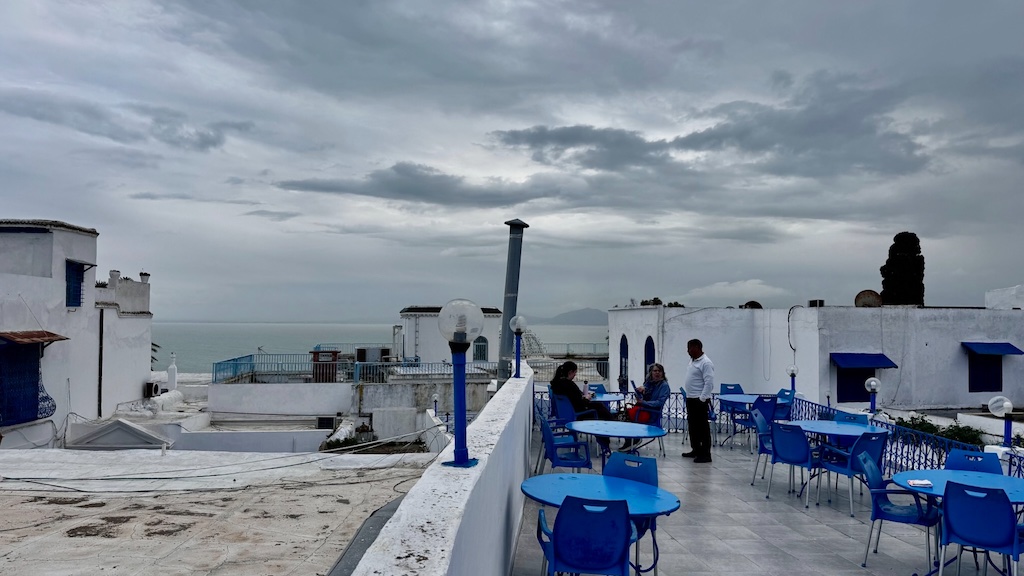
Sidi Bou Saïd
After an exceptionally wet winter, signs of decay and neglect are impossible to overlook in the blue-and-white village centre. Following severe rainfall in January 2026 — up to 300 mm within two days — the national civil defence authority raised its highest alert level, ordered the precautionary evacuation of several buildings and closed off a number of streets. Parts of the historic centre, perched on a plateau of clay layers and permeable formations with slopes of up to 60 degrees, have been structurally destabilised by erosion and are at risk of landslides. This danger appears to have been known for some time, yet so far it has produced nothing more than meetings, commissions and studies — no concrete action.
Even the commemorative plaque installed in the village centre in 2014, marking the centenary of the Tunisian journey made by painters Paul Klee, August Macke and Louis Moilliet, has faded badly and is now barely legible. Despite the cold and overcast weather, a handful of tourists still make their way here. The spectacular Palais Ennejma Ezzahra — Star of Venus — is closed. Built by Rodolphe François Baron d’Erlanger between 1912 and 1922, it is one of the area's main tourist draws, its gardens offering sweeping views over the Bay of Tunis. The Baron left another lasting mark on the village: as early as August 1915, he persuaded the local authorities to make the blue-and-white colour scheme mandatory for all structures, ensuring visual uniformity and preventing uncontrolled development on the plateau. Sidi Bou Saïd thus became the world's first classified heritage site, and the municipal decree of 1915 still obliges all owners to comply with these colour specifications to this day.
The Palais was the first monument to be placed under protection shortly after Tunisian independence in 1956. In 1991/92, it became the headquarters of the newly founded Centre des Musiques Arabes et Méditerranéennes (CMAM) and has since operated as a museum, archive and concert hall — housing the most significant collection of Arabic musical instruments and historical sound recordings in Tunisia.
Listed status, however, does not protect against decay. The museum's gates are shut, despite the opening hours stated on the website and at the gate itself. With some difficulty, we find a guard who tells us the museum is closed for building works — though he has no idea until when. A search online reveals that the Palais had been closed to the public until 26 January following the January rainfall, in the interest of visitor safety and site preservation. Since then, nothing: no further information on the official website, no coverage in the Tunisian media. The events calendar has been empty since December 2025. Rien ne bouge ...
Geological instability, decades of administrative inertia and neglect, and a creeping loss of appeal — all have left their mark.