Back in La Marsa and Tunisia after nearly fifteen years, to take part in a workshop on urban planning in Libya. As the workshop was the cancelled with short notice I had plenty of time to explore, à la recherche du temps perdu .
All looked familiar, yet somehow faded and significantly run-down. a first stop took me to the beach, where the wind was blowing fiercely and the rain soon started to fall – not at all spring-like, as we’d hoped.
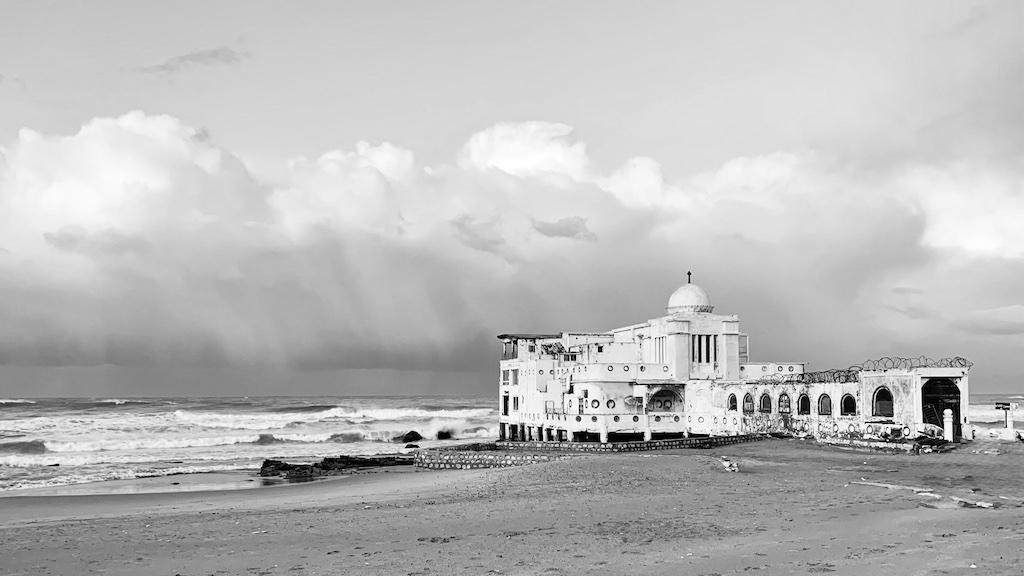
The landmark beach pavilion Koubet El Haoua (قبة الهواء, Qubba al-Hawāʾ) — literally “Dome of the Wind” — stands directly at the water’s edge. In the Arab spring of 2011 it was still gleaming white, and in use for some kind of beach gastronomy. Now it stands empty. Warning signs caution against entering the deteriorating structure.
Looking up the building’s history I learnt that it was built with its Moorish style under the Tunisian Beys in the 19th century. As a summer residence and royal beach retreat it housed the private chambers of the Bey. Combining elegance with privacy, characteristic of Beylikal* summer residences along the Gulf of Tunis, it was was used for official events and receptions.
In the 1960s the building was privatized and later transformed into restaurants, which resulted in fundamental architectural changes to the structure. Due to property disputes, it was closed to the public in 2016, and will probably soon be lost forever, in spite of widespread public outrage at the government’s failure to preserve the monument.
At the roundabout on Place de Palestine, the Librairie-Espace d’Art Mille Feuilles is still there — a place where I often found something worth reading in French. But the shelves tell a different story now. Hardly any new titles, and much of the rather limited stock looks second-hand, dusty, slightly yellowed, much like the town centre of La Marsa itself: stagnation - nothing seems to be moving